

VISIT TO THE ALCAZAR IN SEVILLE
Entering the Alcazar of Seville is more or less a walk across a border that does not only divide the past and the present, but two entirely different worlds, each above the other with a natural ease that comes as a shock in itself to those who yet are unacquainted with the magnetic beauty of the Andalusian city. Right outside the entrance you understand immediately that this is no ordinary palace: here all the arches, all the courtyards, all the tiles, recount the tale of a clash of civilizations which, over the centuries, has formed the character of southern Spain.
A lot of tourists come because of the popularity of this royal complex, which is also utilized by the Spanish monarch whenever they are in the town. But when you stand in front of its honey-colored walls you get another feeling, almost personal, as though the Alcazar did not merely wish to flaunt itself, but to invite you to take your time, examine closely, and be led about.
The story starts long ago. By the time that the caliphs of the Almohad era erected their stronghold here, they could not in any way conceive that this original nucleus, consisting of simple towers and courts, would evolve into a special architectural mosaic in Europe. Each leader contributed something to it over the centuries: rooms, decorations, gardens. Nevertheless, the best part is still the Palacio Mudejar, ordered by Peter I of Castile in the 14th century. An unpopular ruler, indeed, but with such a cultivated taste that he engaged the services of craftsmen at Granada and Toledo. The outcome is a Christian palace adorned with the most exquisite Islamic art, devoid of confrontations, without imposing anything. Pure harmony.
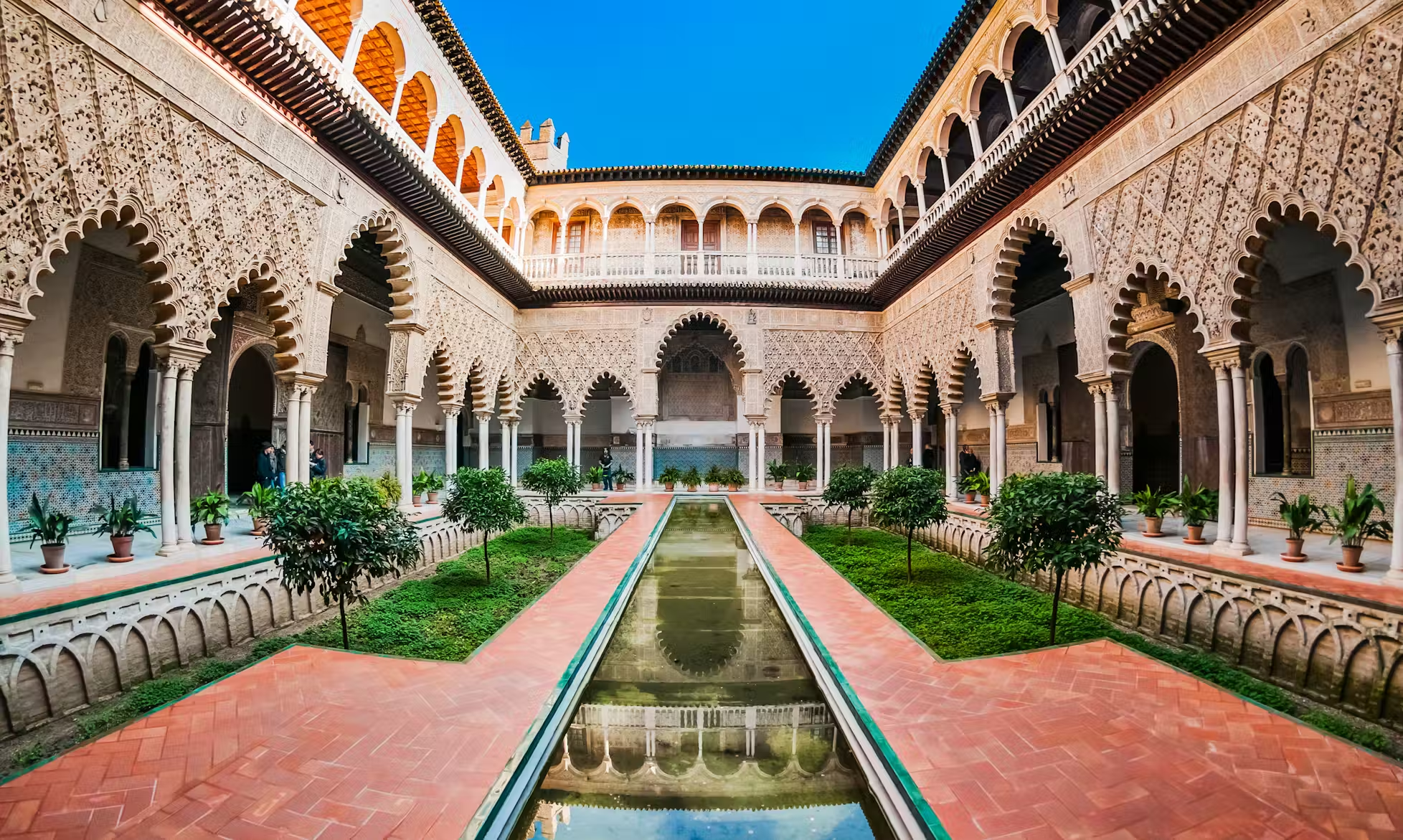
Nowadays, a majority of the visitors to the Alcazar will begin at the Patio de las Doncellas, which is likely the most photographed location in the entire complex. However, one thing if you see a picture and another thing altogether if you are in the middle of that courtyard. The semi silence, the effects of light and shadow, the reflection of the central pool all bring about an almost suspended atmosphere. Looking up, the geometric stuccoes, Arabic inscriptions and brightly colored ceramics appear to blend with each other with an almost hypnotic precision. It is not a place to walk, but to listen.
Shortly after, in the Sala de los Embajadores, you get an impression of strength in medieval Iberia by a single glance of the room. The starry-sky carved golden dome tops a room in which every wall has a political message: here the Castilian kings received ambassadors and foreign dignitaries and displayed to the world the affluence and culture of their court. When you step on the stone floor, you can not but think how many significant decisions were made there, how many alliances, how many negotiations.
And there the gardens. It is not merely an appendage, but an entire world in its own right. When you come out, you are engulfed in the world of orange trees, pergolas, fountains hidden in bushes and mazes of paths. It smells of jasmine, particularly on hot days, and everywhere you go. There are moments when you can hear the echo of water, which the ancient Islamic gardeners believed was a holy ingredient, and it has the ability to develop the landscape. It is practically therapeutic to walk through the Garden of the Prince or the Garden of the Dance: he who has time to rest on a shady bench knows the reason why it was thought a haven of the mind as well as of the body.
The other side there is more recent one, the one that appears frequently in conversations of travelers. The Alcazar halls and courtyards have been used in some of the most popular movies and TV shows, but the reality is that they do not require a movie to make them look magnificent. Their power is in the daily life which pesters through all the pomposity: children swinging down the lanes in the gardens, art students in possession of sketchbooks, couples snapping in a Moorish arch. Everything exists together without being out of place.
Going to the Alcazar is time consuming. It is not so much because it is big, but because it sets the pace. It’s a place to visit at leisure, to look slowly over the finer details which you would otherwise miss: a small tile behind a column, one of the carved ceilings as the light changes, a passage which opens into a small secret garden. Each time people visit Seville, it is a different experience and most of the times they get back they visit again here.
Perhaps, that is the true beauty of the Alcazar: not a museum depiction of perfection, but the continuous dialogue of the eras, languages, and cultures. A place that does not merely display the past – it still exists. And he who enters that gate, even a couple of hours, steals a little bit of it.
Map

Discover the Soul of Andalusia with Seville Pass
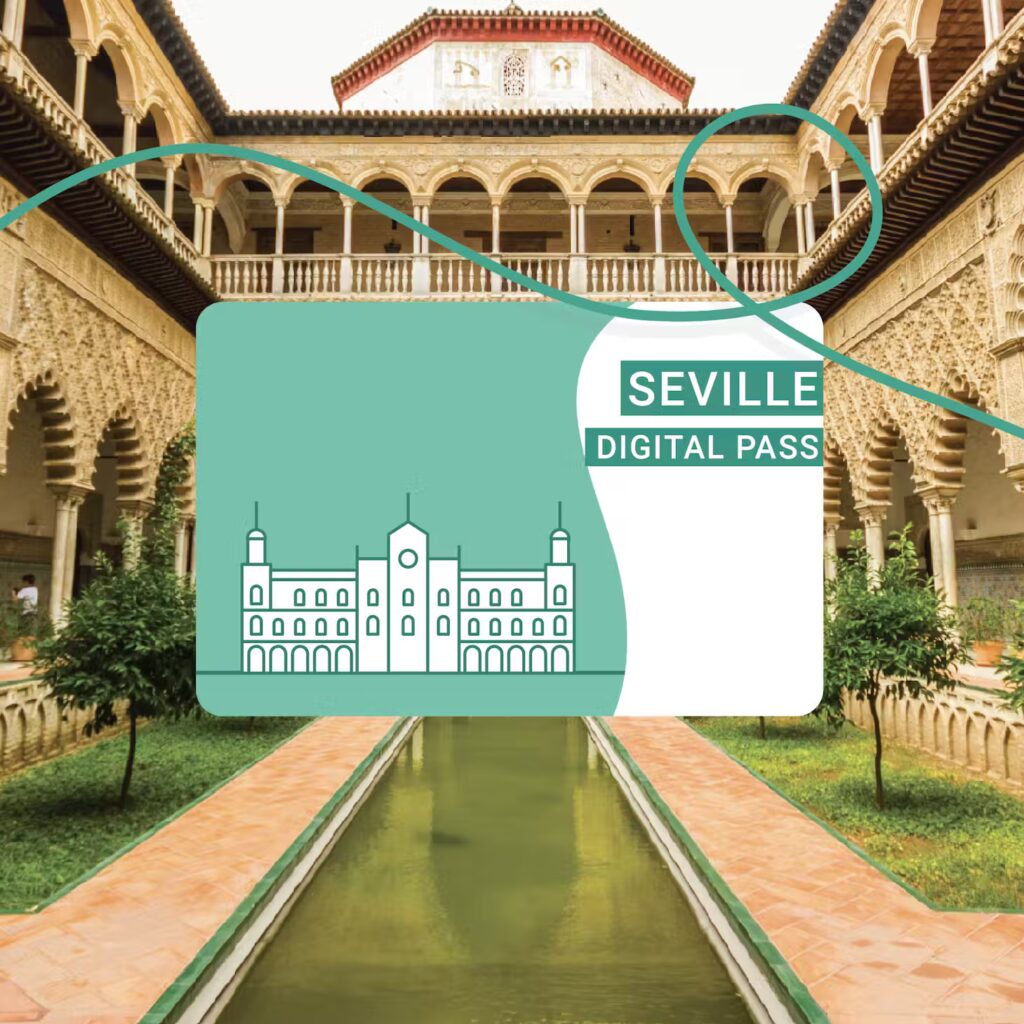
Get the one-stop ticket to the most fascinating attractions of the Mediterranean: the Seville Pass is a ticket to the golden heart of southern Spain. Bypass the queues and plunge into Royal Alcazar of Seville, a palace that is so beautiful it seems like a tile and sunlight dream. You can stroll across courtyards covered with orange blossoms, enjoy elaborate Moorish arches, and recreate some Game of Thrones scenes shot inside its ancient walls.
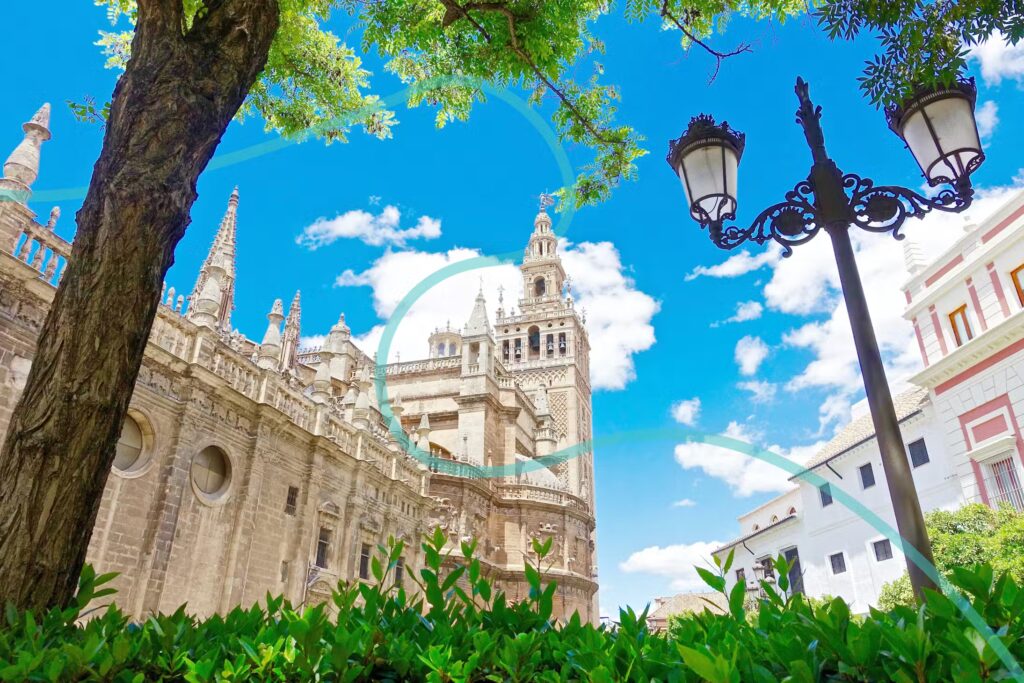
But the witchcraft does not end there. Included in the Seville Pass is the Seville Cathedral, which is the largest Gothic cathedral in the world, and the famous Giralda Tower that you may climb to unbelievable views of the city that stretches in every direction, including the rooftop of the Andalusian region. Now add in the ability to listen to a highly rated audio guide application and you will hear history, legends and tips of people who know it all. One pass, endless charm—your Seville story starts here.
Bundle & Save More
- BEST DEAL
- BEST DEAL
Useful info
Opening hours
The Real Alcázar is open every day of the year except 1 January, 6 January, Good Friday, and 25 December. Hours are usually 09:30–19:00 (last entry 18:00) in high season and slightly shorter in winter. Evening openings or special events can change things, so always check the official schedule for your date.
Location
The palace sits right in Seville’s historic heart, next to the Cathedral and La Giralda, facing Plaza del Triunfo. The official address is Patio de Banderas, s/n, 41004 Sevilla, Spain—a beautiful enclosed square at the edge of the Santa Cruz neighborhood, wrapped in narrow, whitewashed streets.
How to get there
The easiest way to reach the Real Alcázar is to head toward Seville’s old town and Cathedral area. From elsewhere in the city you can take tram line T1 or metro to Puerta de Jerez, or use city buses stopping around Puerta de Jerez / Prado de San Sebastián / Menéndez Pelayo; from these stops it’s a short walk through the historic streets to Puerta del León, the main entrance. Taxis can drop you near Plaza del Triunfo, just a few steps from the gate.
Best time to visit
For a quieter visit, arrive at opening time or in the late afternoon when courtyards are calmer and queues shorter. Midday, especially in spring weekends and high summer, is busier and hotter. Weekdays outside local holidays tend to feel much more relaxed. You can then enjoy the gardens calmly too.!
Duration of the visit
Plan at least 2–3 hours to enjoy the main palaces, patios, and a wander in the gardens without rushing; history and architecture fans can easily stretch it to half a day. Add extra time if you like guided tours, photo stops, or just sitting quietly in the shade listening to fountains and birds.
Accessibility
Opening hours
The Real Alcázar is open every day of the year except 1 January, 6 January, Good Friday, and 25 December. Hours are usually 09:30–19:00 (last entry 18:00) in high season and slightly shorter in winter. Evening openings or special events can change things, so always check the official schedule for your date.
Location
The palace sits right in Seville’s historic heart, next to the Cathedral and La Giralda, facing Plaza del Triunfo. The official address is Patio de Banderas, s/n, 41004 Sevilla, Spain—a beautiful enclosed square at the edge of the Santa Cruz neighborhood, wrapped in narrow, whitewashed streets
How to get there
The easiest way to reach the Real Alcázar is to head toward Seville’s old town and Cathedral area. From elsewhere in the city you can take tram line T1 or metro to Puerta de Jerez, or use city buses stopping around Puerta de Jerez / Prado de San Sebastián / Menéndez Pelayo; from these stops it’s a short walk through the historic streets to Puerta del León, the main entrance. Taxis can drop you near Plaza del Triunfo, just a few steps from the gate.
Best time to visit
For a quieter visit, arrive at opening time or in the late afternoon when courtyards are calmer and queues shorter. Midday, especially in spring weekends and high summer, is busier and hotter. Weekdays outside local holidays tend to feel much more relaxed. You can then enjoy the gardens calmly too.!
Duration of the visit
Plan at least 2–3 hours to enjoy the main palaces, patios, and a wander in the gardens without rushing; history and architecture fans can easily stretch it to half a day. Add extra time if you like guided tours, photo stops, or just sitting quietly in the shade listening to fountains and birds.
Accessibility
The Real Alcazar offers partial accessibility for visitors with reduced mobility. Many ground floor rooms and parts of the gardens have flat paths or ramps, though you will still find cobblestones, steps and some upper levels with no lift. There are adapted routes and guided tours, and staff can suggest the smoothest way so you can plan ahead with more confidence. Check access details before your visit to shape the best route.
what to see at Royal Alcazar Seville
The initial impression that you get, once you enter the Alcazar of Seville, is that you are in the presence of a location, which does not provide shortcuts. Each step is something: a stucco fragment, a doorway opening to an inexplicable patio, a dim room wherein the light appears to filter in with hesitancy. In case you are not sure what you really ought to see in this monumental complex, the answer is simple on the surface all. The Alcazar being a succession of worlds superimposed, you should pay attention to every one of them.
It is typical to make the visit beginning at the Patio del Leon, a wide entrance space that gives you an overview of what lies ahead. In this case the palace is not yet fully disclosed, however, you can already feel the mixture of medieval, Renaissance and Mudejarian. One feels as though he was opening the first page of a book with a lot to promise when looking at the ochre-colored walls, with the Lion Gate displaying the heraldic emblem of the animal.
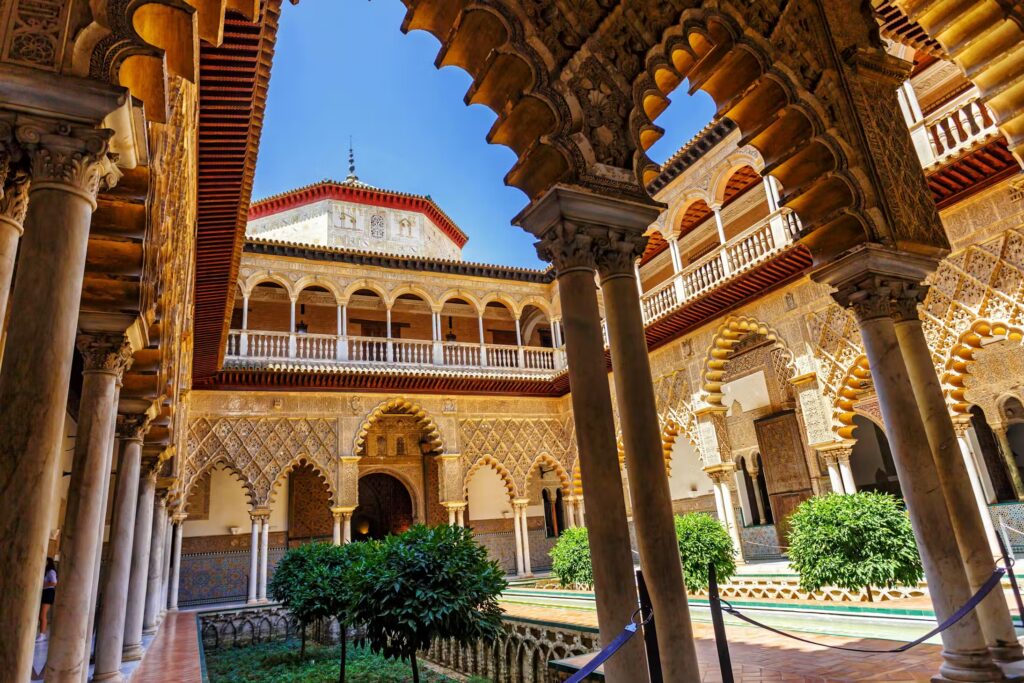
Next there is the real magic, the Palacio Mudejar, ordered to be built by Peter I of Castile in the 14th century. It is the place to relate the history of the soul of the Alcazar better than any other. The long pool of reflecting patio de las Doncellas, with its elaborate arches, strikes your eye first. But it is not a place that merely attempts to seduce you. It is almost bursting with decorative richness: the more you take a look, the more things you see that you saw the first time. The sculpted plaster, the Arabic inscriptions that are hundreds of years old, and the tiles that have geometric designs all seem to be the pieces of the same sentence, but that are pronounced in a different tone in each corner.
You go a little further and arrive at the Sala de los Embajadores, which is perhaps the most dramatic room in point of view. The golden dome, which was finished in the manner of a gigantic nest of carved wood, is an imposing object that must have been a terror to a guest of the sovereign in days gone by. It is natural to think of foreign representatives and envoys with word in foreign countries: this was the political core of the palace, where even every detail of construction served also as political message.
Then the beat is different altogether: the gardens. Here the Alcazar reveals its closest side. Not only green areas, but a maze of lanes, pergolas, concealed pavilions and fountains that follow behind the sound of running water. The Prince garden, the Garden of the dance, the Labyrinth – all have their mood. Even the light appears to shift between spaces. There are individuals who prefer walking silently enveloped in the fragrance of orange trees and jasmine. Others stand and observe a peacock striding forth over the walks in a royal manner: and after all, all living creatures have long been at home here.
Nevertheless, as you proceed with the visit, you arrive at the Renaissance quarters, like the Palacio Gotico, which was constructed following the earthquake of 1356. Here the eye is accustomed to another aesthetic: less conspicuous ceilings, huge halls, another type of echo. And still the contrast does not seem out of place. It is a part of the Alcazar identity, and it was always made by kings and architects who belong to the very distant past. There are temporary exhibitions in the Gothic halls that you frequently visit but empty spaces that present the story without the addition of anything.
Among the most unexpected things about the visit is the finding of the Bano de Dona Maria de Padilla, a medieval cistern, which is akin to a story. The light penetrating through the barrel vaults and bouncing off the water, the almost surreal atmosphere has made this one of the most photographed and at the same time one of the most silent of the entire complex. The time does appear to freeze here.
Most of the travelers recall the Alcazar in terms of what they saw on the screen, yet the reality is that the movie makers have not done anything to make the Alcazar even more attractive they have simply opened it up to more people. There is no need of special effects in its beauty. You just have to walk, and hear the sound of your footsteps on the old floor, and be led around by the views.
And what wilt thou see in the Alcazar Sevillian? And everything, pick and choose not, In a hurry. It is a city within the city, a living archive where various eras address each other without contradiction. and in going you carry away a sense which is difficult to delimit, the sense of having passed through not only a scene, but a narrative which is continually evolving with recurrence.
FAQ
Do I Need to Book Tickets in Advance for the Real Alcazar of Seville?
Yes, booking in advance is highly recommended. The Real Alcazar has daily visitor limits and often sells out, especially during weekends, holidays, and peak season.
What Types of Tickets Are Available for the Real Alcazar of Seville?
You can choose standard entry tickets, skip-the-line tickets, guided tour tickets, and combination passes that include the Cathedral or Giralda Tower. Night visits are also offered on selected dates.
Where Can I Buy Tickets for the Real Alcazar of Seville?
You can purchase tickets directly on our website. As an official partner of Tiqets.com, we provide reliable and easy access to tickets for all major attractions, ensuring a seamless booking experience. Online booking helps you secure a specific entry time and avoid long queues.
Can I Get a Refund or Reschedule My Tickets?
Are There Discounts Available for Tickets?
Many attractions offer discounts for children, students, seniors, and families. Some sites also provide reduced prices for online bookings or during off-peak hours. Be sure to check eligibility requirements before purchasing. EU citizens aged 17 to 25 often receive reduced fares, and children under a certain age may enter free.
What Are Combination Passes and Are They Worth It?
Absolutely! Combo passes such as Alcázar + Cathedral + Giralda Tower let you see Seville’s top attractions with one simple booking. They’re usually cheaper than buying separately and make your sightseeing smoother.
What Happens If I Miss My Time Slot?
If you miss your allotted time slot, entry is not guaranteed. Visitors are advised to arrive at least 15 minutes before their scheduled access time.
Is the Real Alcazar of Seville Wheelchair Accessible?
Parts of the Alcazar are accessible, but due to its historical layout, some areas include uneven surfaces and stairs. Accessible routes are available and staff can provide assistance.
Can I Take Photos Inside the Real Alcazar?
Does the Ticket Include Access to the Gardens?
Yes, standard tickets include access to the gardens. Some tickets may include special exhibitions or guided experiences depending on the option you select.
Are Guided Tours Worth It?
Guided tours are highly recommended if you want to understand the historical significance, architectural details, and stories behind the palace. They also provide a more structured and time-efficient visit.